Nano Banana Pro vs GPT Image 2.5: Same Restaurant Promo Prompt
For this smoked-brisket ramen promo, I would choose GPT Image 2.5 over Nano Banana Pro: it reproduced all three text elements, showed both egg halves and visible noodles, and cost 7 credits versus 19. Nano Banana Pro also matched the wording, but showed only one egg half and no visible noodles. These are individual text-only generations, so this comparison does not establish repeatability, reference-photo accuracy or print quality.
Which model wins for restaurant promo images? (quick verdict)
We compared four outputs for ingredient completeness, food texture, camera angle, restaurant context and exact wording. All four matched the dish name, price and tagline in the examples shown. The useful differences were in the food and composition; this test does not measure how often each model succeeds.
One paid Kubflow subscription gives access to every model through one credit balance. Plans start at $19 a month; Growth costs $49 a month for 4,500 credits. The dollar estimates below use $49 ÷ 4,500 × the recorded credits, rounded to the nearest cent. They represent the value of credits within that subscription. Every generation shows its exact price before it runs.
| Model | Recorded settings | Credits for this output | Approx. Growth credit value | Wording in this output | Visible tradeoff |
|---|---|---|---|---|---|
| Nano Banana Pro | 16:9; 1K | 19 | $0.21 | All three elements exact | One egg half; no visible noodles; repetitive meat surface lines |
| GPT Image 2.5 | 16:9; 1K; background auto | 7 | $0.08 | All three elements exact | Both egg halves and noodles; heavily glossy surfaces; little restaurant context |
| Seedream 5 Lite | 16:9; quality basic | 6 | $0.07 | All three elements exact | Curled front beef slice; one egg half; lower camera angle |
| Nano Banana 2.1 | 16:9; 1K | 5 | $0.05 | All three elements exact | Both egg halves and noodles; lower camera angle; serif tagline |
How we compared four outputs from the same prompt
The four recorded generations used the identical prompt printed below. Each used prompt-only input with no start image and a 16:9 aspect ratio. Nano Banana Pro and Nano Banana 2.1 used 1K resolution; GPT Image 2.5 used 1K resolution with background set to auto; Seedream 5 Lite used quality basic. The recorded costs were 19, 5, 7 and 6 credits respectively.
This is a comparison of four individual outputs. It does not measure success rates, model-specific prompt optimization, editing quality, reference-photo fidelity or print quality.
Overhead three-quarter food photograph of a steaming bowl of smoked brisket ramen on a dark walnut table in a cozy neighborhood restaurant. Glossy tonkotsu broth, thick slices of smoked brisket with a pink smoke ring, a jammy soft-boiled egg cut in half, scallions, nori and chili oil. Warm side light, soft steam rising, shallow depth of field. Clean bold sans-serif text in the upper left reads "SMOKED BRISKET RAMEN" with "$16" below it, and a small line at the bottom reads "Every Friday Night". Realistic, appetizing editorial food photography.
Nano Banana Pro: exact wording, incomplete toppings
Overhead three-quarter food photograph of a steaming bowl of smoked brisket ramen on a dark walnut table in a cozy neighborhood restaurant. Glossy tonkotsu broth, thick slices of smoked brisket with a pink smoke ring, a jammy soft-boiled egg cut in half, scallions, nori and chili oil. Warm side light, soft steam rising, shallow depth of field. Clean bold sans-serif text in the upper left reads "SMOKED BRISKET RAMEN" with "$16" below it, and a small line at the bottom reads "Every Friday Night". Realistic, appetizing editorial food photography.
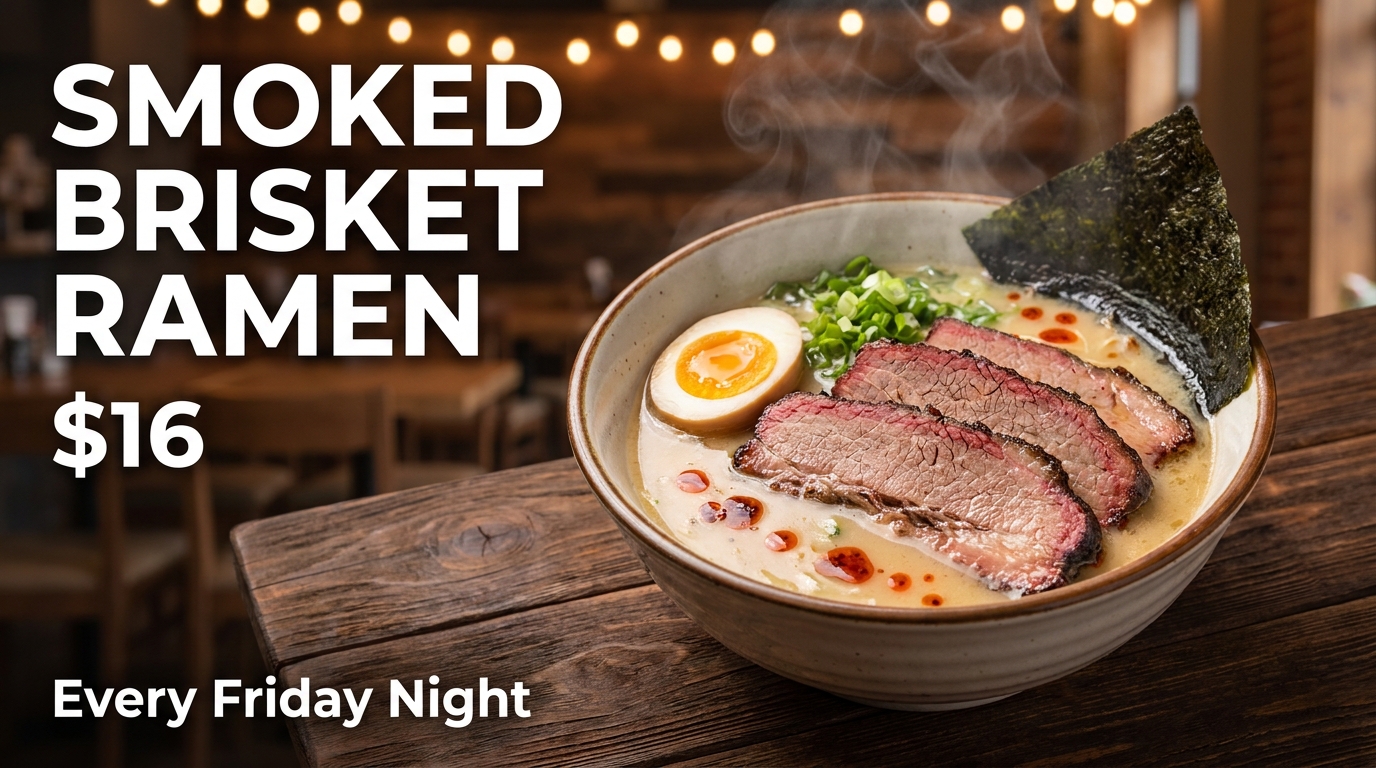
In this output, Nano Banana Pro placed the bowl on a dark wooden table with warm string lights in the blurred background. Warm side lighting and curling steam follow the prompt. The bowl shows creamy broth, thick brisket slices, scallions, nori and chili oil, but only one egg half and no visible noodles. The camera angle is lower than requested, and the meat has pronounced, somewhat repetitive branching surface lines.
All three text elements match the requested wording: ‘SMOKED BRISKET RAMEN’ and ‘$16’ appear in bold sans-serif lettering at the upper left, with ‘Every Friday Night’ at the bottom left. No obvious malformed objects or distorted letters are visible.
Nano Banana Pro costs 19 credits for one 1K image. Kubflow’s model guide describes sharper 2K imagery, better text rendering, strong world knowledge, localisation and brand consistency. This comparison used a 1K generation and does not demonstrate an advantage for printed menus or posters.
For the best results with Nano Banana Pro, the prompt guide recommends describing the scene in one or two flowing paragraphs rather than a list of keywords. You should outline the subject, action, place, composition, style, camera, and light, while transcribing any label text directly into the prompt.
GPT Image 2.5: complete toppings at 7 credits
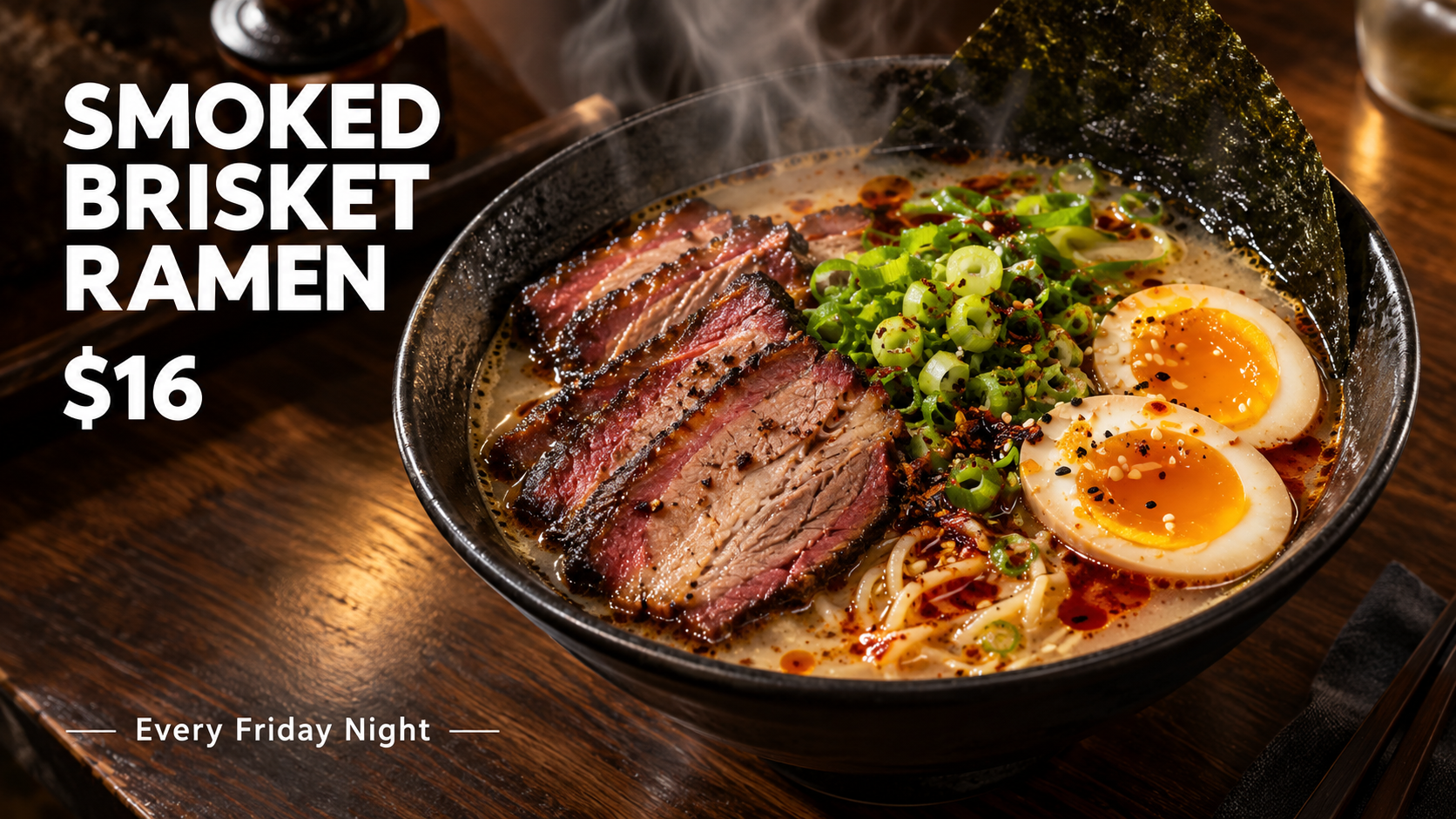
Overhead three-quarter food photograph of a steaming bowl of smoked brisket ramen on a dark walnut table in a cozy neighborhood restaurant. Glossy tonkotsu broth, thick slices of smoked brisket with a pink smoke ring, a jammy soft-boiled egg cut in half, scallions, nori and chili oil. Warm side light, soft steam rising, shallow depth of field. Clean bold sans-serif text in the upper left reads "SMOKED BRISKET RAMEN" with "$16" below it, and a small line at the bottom reads "Every Friday Night". Realistic, appetizing editorial food photography.
GPT Image 2.5 cost 7 credits for this 1K output. Its elevated three-quarter view shows browned brisket edges with pink bands, two jammy egg halves and visible noodles in creamy broth. The surfaces look heavily glossy. The tight crop gives little evidence of the requested neighborhood restaurant setting.
The dish name, price and tagline match the requested wording and capitalization, with the title and price at the upper left and the tagline along the bottom. No obvious malformed objects or text errors are visible. Kubflow’s prompt guide describes GPT Image 2.5 as first on every public leaderboard for photorealism, product images, portraits, text and editing; the evidence here is limited to this one output.
GPT Image 2.5 supports up to 16 reference images and transparent backgrounds. For a real menu item, use a dish photo as a reference and explicitly request its ingredients, portions, bowl and colours. Inspect the output against that photo before using it. This example used no references and background auto, so it does not demonstrate dish preservation or a transparent cutout.
Kubflow’s GPT Image 2.5 prompt guide recommends a creative brief in short labelled lines ordered as use, scene, subject, key details and constraints. Include a lighting setup and the shot size, angle and lens. Quote each text element, request that each appears exactly once, and specify its position, size, weight and colour. Add ‘no other text, no watermark’.
Seedream 5 Lite and Nano Banana 2.1: are the cheap options good enough?
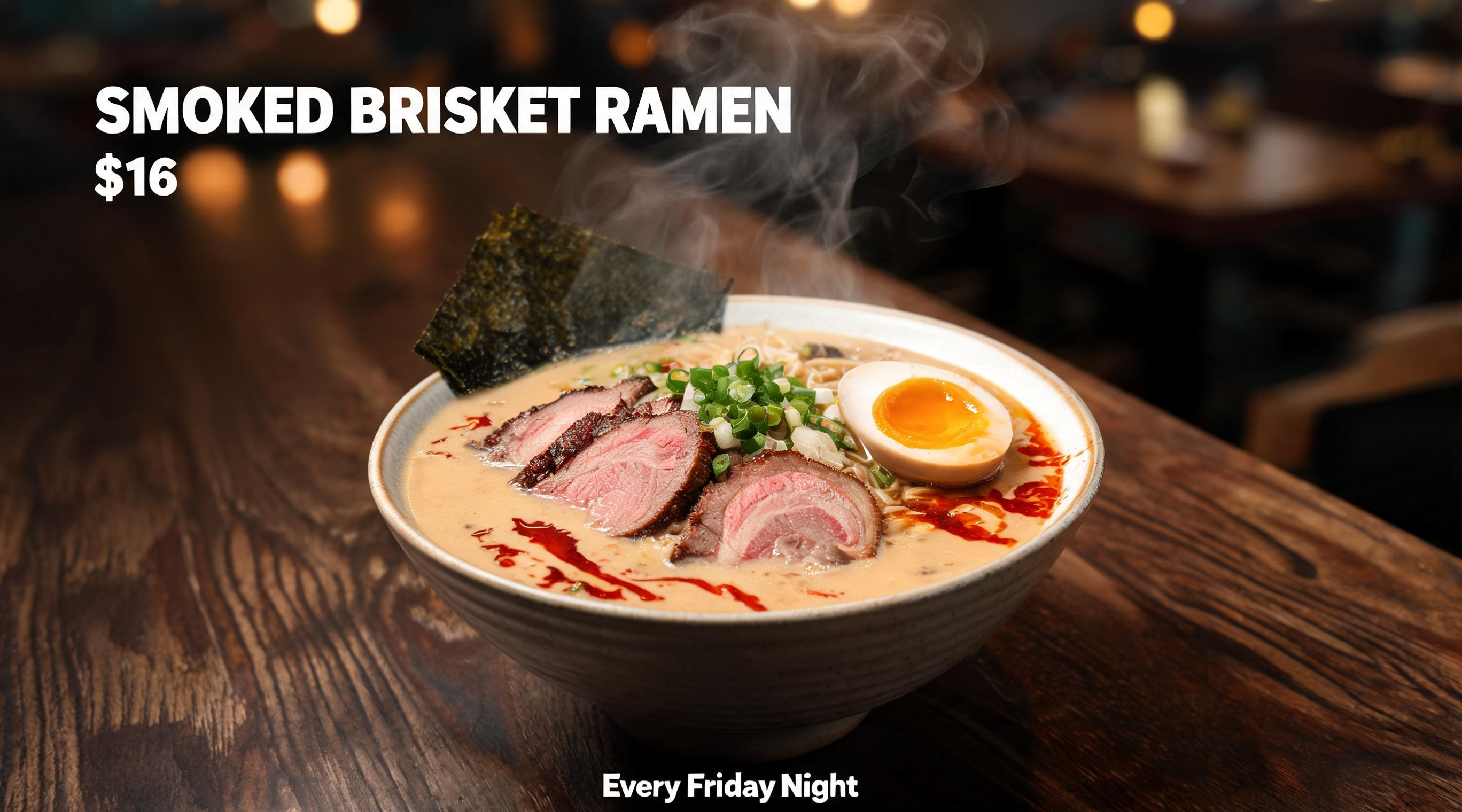
Overhead three-quarter food photograph of a steaming bowl of smoked brisket ramen on a dark walnut table in a cozy neighborhood restaurant. Glossy tonkotsu broth, thick slices of smoked brisket with a pink smoke ring, a jammy soft-boiled egg cut in half, scallions, nori and chili oil. Warm side light, soft steam rising, shallow depth of field. Clean bold sans-serif text in the upper left reads "SMOKED BRISKET RAMEN" with "$16" below it, and a small line at the bottom reads "Every Friday Night". Realistic, appetizing editorial food photography.
Seedream 5 Lite cost 6 credits for this 16:9 output at quality basic. All three text elements are spelled exactly as requested; the title and price are bold white sans-serif, and the smaller tagline is also bold. Warm side lighting and steam are visible. The front beef slice has an unusually curled, concentric structure, the smoke ring is not consistently distinct, only one egg half is visible, and the camera angle is lower than requested.
Seedream 5 Lite supports 2K or 4K output, and Kubflow’s guide recommends it for drafts and variations while noting weaker realism and structure than Seedream 5 Pro. The recorded setting for this example was quality basic; its output resolution was not specified in the record.
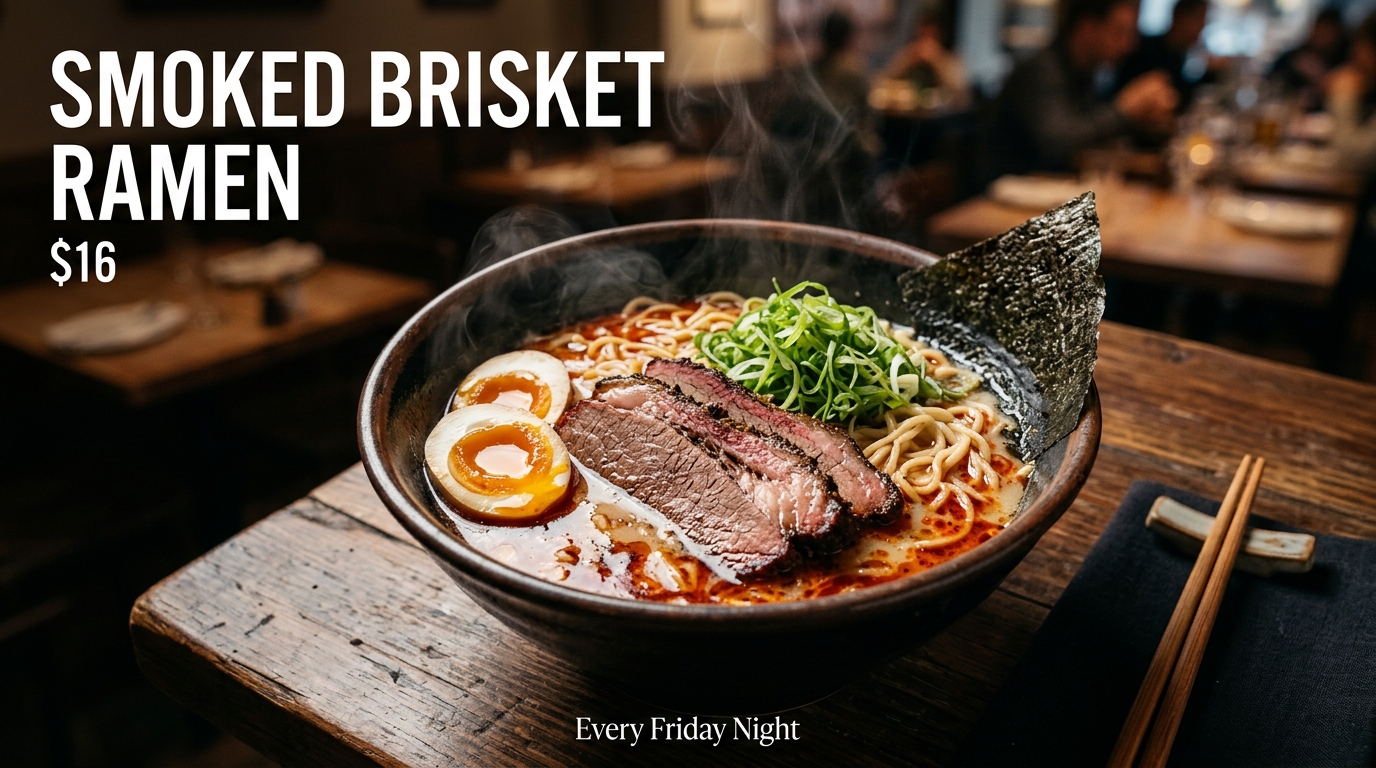
Overhead three-quarter food photograph of a steaming bowl of smoked brisket ramen on a dark walnut table in a cozy neighborhood restaurant. Glossy tonkotsu broth, thick slices of smoked brisket with a pink smoke ring, a jammy soft-boiled egg cut in half, scallions, nori and chili oil. Warm side light, soft steam rising, shallow depth of field. Clean bold sans-serif text in the upper left reads "SMOKED BRISKET RAMEN" with "$16" below it, and a small line at the bottom reads "Every Friday Night". Realistic, appetizing editorial food photography.
Nano Banana 2.1 cost 5 credits for this 1K output, making it the least expensive of the four examples. It matched all three text elements and showed noodles, two egg halves and brisket with visible pink edges. The camera angle is lower than requested, and the bottom tagline uses smaller serif type.
Nano Banana 2.1 supports up to 10 reference images. Kubflow describes it as Google’s fast image model with near-Pro quality. This example used no references; it demonstrates a promising inexpensive result for this prompt.
Which one should a restaurant or food brand actually use?
For a lower-cost next test, try Nano Banana 2.1. Its 5-credit example included both egg halves, visible noodles and exact wording. All four recorded outputs were landscape 16:9; vertical story layouts and consistency across multiple angles were not tested.
This comparison gives no tested reason to pay more for Nano Banana Pro on the basis of printing: both main models matched the text, and both recorded generations used 1K resolution. If you need a print asset, inspect food detail, lettering and resolution at the intended print size. Topaz Image Upscale supports 1x, 2x, 4x or 8x scaling with a maximum 10MB input; we did not test it here.
Between the two headline models, GPT Image 2.5 is my choice for another test of this ramen promo because its example showed the requested toppings more completely at 7 credits. For an actual menu, try a real dish photo as a reference and compare the result carefully. Transparent backgrounds are supported, but were not used here. Kubflow also offers Remove Background for PNG, JPG and WebP images up to 5MB and 4096px.
You do not need separate subscriptions to test these providers. A single Kubflow plan lets you compare GPT Image 2.5, Seedream, and the Nano Banana series side by side to see which model best matches your restaurant's brand.
Copy this prompt template for your own dishes
The shared prompt above reproduces the instructions used for these examples. The brief below is an untested template for a new vertical promo. Replace every bracketed field, and include the reference instruction only when you supply a real dish photo.
Use: Vertical restaurant social promo.
Scene: [RESTAURANT SETTING], with a simple background and clear space for the offer.
Subject: [DISH], showing [EXACT INGREDIENTS AND PORTIONS] in [BOWL OR PLATE].
Key details: Warm side lighting with soft highlights. Medium shot from an elevated three-quarter angle, 50mm lens; keep the toppings clearly visible.
Constraints: If supplied, Image 1 is the real dish; preserve its ingredients, portions, bowl and colours. Render "[DISH NAME]" exactly once in large, bold white sans-serif type at the upper left; "[PRICE]" exactly once beneath it in medium bold white type; and "[TAGLINE]" exactly once at the bottom in small regular white sans-serif type. Keep all lettering readable. No other text, no watermark.
To reproduce the comparison, open Kubflow’s Image generator, choose a model and paste the shared prompt. Use the settings recorded in the table and check the displayed price before running. The four recorded generations totalled 37 credits, about $0.40 of Growth-plan credit value. Inspect the dish name, price, tagline, ingredients, portions and camera angle before choosing an image for your promotion.
Questions
How much does Nano Banana Pro cost per image?
Nano Banana Pro costs 19 credits for one 1K image on Kubflow. On the Growth plan, which costs $49 for 4,500 credits, this equals about $0.21 per image.
Can GPT Image 2.5 generate images with transparent backgrounds?
Yes. GPT Image 2.5 supports generation and editing with transparent backgrounds. The example in this post used background auto, so it does not demonstrate transparent-background output.
Which AI model is best for rendering text on images?
Kubflow’s prompt guide ranks GPT Image 2.5 first on public leaderboards for text, photorealism and product photography. In this comparison, all four outputs matched the dish name, price and tagline exactly. One output per model cannot establish text success rates, and this test does not establish a print-specific advantage for Nano Banana Pro.
Is there a free plan for Kubflow image models?
No, Kubflow does not offer a free plan. Generating images requires a paid subscription, which starts at $19 a month.